Yesterday, Queen Elizabeth II died at the age of 96 surrounded by her family at Balmoral Castle in Scotland. With that her 70-year reign comes to an end and her son Charles becomes the new King of Great Britain.
She was born in Mayfair, London, on April 21, 1926.
This year she celebrated her 70th anniversary as Queen of Great Britain. And that, even though, nobody really thought her to accend the throne one day. That is because back then, the King of Great Britain was Edward VIII who was the brother of Elizabeth’s father Georg VI. In December 1936, however, King Edward abdicated so he could marry Wallis Simpson, an American who had been divorced twice. As a result, Georg VI became the King on December 11, 1936; his oldest daughter Elizabeth became heir to the throne. When in 1952, Georg VI died at the age of 56, Elizabeth II was crowned and has been Queen of Great Britain ever since.
Coat of Arms of Queen Elizabeth II
Queen Elizabeth II beared the coat of arms of Great Britain. It is the symbol of her royal souvereignty.
Von Sodacan – Eigenes Werk, CC BY-SA 3.0, https://commons.wikimedia.org/w/index.php?curid=21101265
Quarterly, first and fourth Gules three lions passant gardant in pale Or armed and langued Azure (for England), second quarter Or a lion rampant within a double tressure flory-counter-flory Gules (for Scotland), third quarter Azure a harp Or stringed Argent (for Ireland), the whole surrounded by the Garter; for a Crest, upon the Royal helm the imperial crown Proper, thereon a lion statant gardant Or imperially crowned Proper; Mantling Or and ermine; for Supporters, dexter a lion rampant gardant Or crowned as the Crest, sinister a unicorn Argent armed, crined and unguled Proper, gorged with a coronet Or composed of crosses patée and fleurs de lis a chain affixed thereto passing between the forelegs and reflexed over the back also Or. Motto ‚Dieu et mon Droit‘ in the compartment below the shield, with the Union rose, shamrock and thistle engrafted on the same stem.
In 1944, Queen Elizabeth received her first coat of arms. It consisted of a lozenge-shield showing the royal coat of arms of the United Kingdom with a silber label of three points (the one in the middle with a Tudor rose, the others with the St George’s Cross). She bore the coat of arms below until 1947.
In 1947, the motto of the Order of the Garter was added. The coat of arms shown below is the one Queen Elisabeth II bore until her coronation in 1952. Ever since then, she has been bearing the coat of arms of Great Britain.
https://pro-heraldica.de/wp-content/uploads/2016/04/496px-Royal_Coat_of_Arms_of_the_United_Kingdom.svg_.png480496Alexandra Scheiderbauerhttps://pro-heraldica.de/wp-content/uploads/2018/07/Logo_156-hoch.pngAlexandra Scheiderbauer2022-09-09 16:31:332022-09-15 11:21:11Coat of Arms of Queen Elizabeth II
When somebody makes a trip to Stuttgart, Germany, it is often to pick up their new Mercedes or Porsche. But there are also people who come here to receive the coat of arms patent of their family crest or the results of their genealogical research.
On Thursday, November 12, Christian Reisinger visited us exactly for this reason.
Of course, we are also curious to learn about the motivations that bring customers to our company’s headquarters.
Christian Reisinger’s reasons for his coat of arms commission
Mr. Reisinger’s mother died this year, his father ten years ago. When his little son was born on June 10 of this year, the desire grew that he could one day leave something to his son, that tells him about his roots.
Even though the slogan of the Reisinger familiy says to always look forward and never back, it is very important for them to know about their roots and their family’s history.
That is why Mr. Reisinger began to browse his parents‘ estate for documents that might illuminate some details about his family history. Unfortunately, there was not much to be found.
According to stories his father once told him, the family used to have a family crest in earlier times. Naturally, he was now eager to find it. Our researchers, however, were not able discover said coat of arms, as a result Mr. Reisinger decided to create a new one.
He did so to honor the lifetime achievement of his father who in all areas of life – private as well as business – served him as a role model.
Handing over the Coat of Arms
On November 12, time had finally come for Mr. Reisinger to receiv his leather bound commission report and the coat of arms patent.
Here is a quote from Christian Reisinger:
„It is important for me to mention, that I had the fullest confidence in Pro Heraldica at all times of our cooperation. The communication with Mrs. Gruschka, Dr. Sutter and Mrs. Heimbach – in person or via telephone – has always been an enrichment for me and I felt splendidly taken care of. I can really recommend Pro Heraldica to everyone who wants to create a coat of arms or have research done on their family history!“
Something that we see regularly is an institution or a university wanting to discard the coat of arms that they have and substitute for it a logo. The usual reason given for this change is that a coat of arms is “a little old-fashioned,” that it has “an older look to it.” By this is generally meant that it’s “outdated” and not “contemporary,” and that they’d like to change it for something “more relevant” and “modern.” (Yes, those are all real quotes by different people talking about their organization’s coat of arms and why it ought to be changed.) As it often happens, these institutions will sometimes pay hundreds or even thousands of Euros (or pounds sterling, or US dollars) to a graphic design company to create a new “brand” which will boost their image as relevant to contemporary times.
Among the difficulties of taking this course of action, however, in addition to the (often excessive) cost, is that in just a few years, their “modern,” “contemporary” logo will itself be “outdated” and have to be replaced, again at high cost, by something even newer.
A coat of arms is not like a trademark
I have to wonder, though, if part of this issue lies in the fact that many people believe that a coat of arms is just like a trademark; that it absolutely, positively must be drawn exactly the same way every time it appears. It is true that this is the case with a logo or a trademark; the exact depiction, and even the shades of the colors used, must be the same every time.
But this is not the case with heraldry, as just a little research can demonstrate. Different artists may draw differing interpretations of a coat of arms; they may use slightly different shades of the colors; they might even choose to display it on a shape other than a shield; and they could certainly draw it in different artistic styles, whether traditional, Baroque, Art Deco, modern, or any other style. None of those things changes the coat of arms itself; it only changes the way it may be perceived.
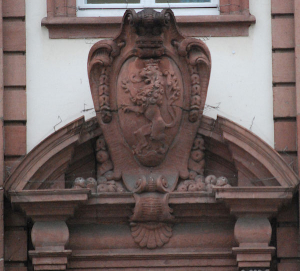
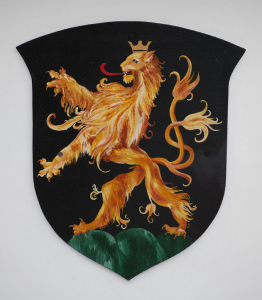
Coat of arms of Heidelberg, Germany
As one example of this, let us look at the coat of arms of the City of Heidelberg, Germany, which can be seen in various styles all around in the „Altstadt“, the Old City portion of Heidelberg.
You can find
Heidelberg’s coat of arms carved in stone
Painted into stained glass
Printed onto fabric
Cast in metal
Painted onto a wooden surface
Painted and fired onto a ceramic panel
Cast into the door handles of a public building
And even – my personal favorite –Carved in the round
without even being placed on a shield of any kind (Although on this last they do have the lion holding a scepter and orb, which do not appear in any of the other depictions.)
The different styles, from very traditional to Baroque to Art Deco, are easy to see. And this same coat of arms can easily be further “modernized” in the future to match changing tastes in art and design.
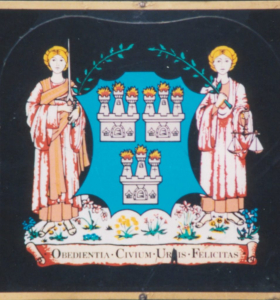
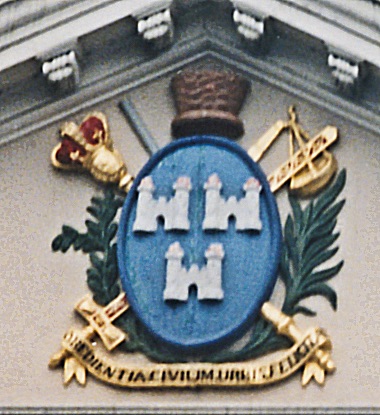
Coat of arms of Dublin
Another example of how a coat of arms may be “updated” to meet changing artistic needs can be seen in the depictions of its coat of arms in and around City of Dublin, Ireland. The arms consist of a blue shield with three white castles whose towers are topped with flames. Walking about the central part of the city, these arms can be seen in a very traditional fashion
on a bicycle rack
On the side of a public building
In traditional fashion
on many of the city’s street lamps, both colored and monochrome
In a simplified version
on waste receptacles placed about the city
In a very modern logo style
on city-owned services sites and vehicles (again, both colored in blue and white or monochromatic in black and white)
and finally
In an extremely stylized fashion cast
in metal access covers on the sidewalk.
Each version, traditional and modernized, is the same coat of arms that the city of Dublin has used for centuries. (The arms were officially granted in 1607, but elements of it appear in the city’s seal as early as the 13th Century.) Notice also that these different depictions are often placed on entirely different shapes of display, from traditional shield shapes and ovals to horizontal rectangles with semi-circular “bites” taken out of the corners.
There is no need to pay some graphic design firm hundreds or even thousands of Euros/pounds/dollars for a new logo that is “contemporary” and “updated.” Simply redraw the arms that already exist into a more modern style, and there you have the “new” brand, which is really just a new version of the “outdated” and “old-fashioned” brand!
https://pro-heraldica.de/wp-content/uploads/2018/08/Coat-of-arms-Heidelberg-glass.jpg9581000David Appletonhttps://pro-heraldica.de/wp-content/uploads/2018/07/Logo_156-hoch.pngDavid Appleton2018-08-08 09:20:082020-09-25 11:43:13Should Heraldry Be Replaced by a Logo?
Isn’t it more than a bit outdated, something best left to the realm of antiquarians and historians? Does it have any place in the modern United States? “I asked the children what the little crowned hearts and diagonal bars, the golden fleur-de-lys, and the rampant lions meant. They studied the enigmatical mixture of lions and animals for some moments, and shook their heads, one young hopeful declaring that all they meant was that the people who had them thought they were better than the people who hadn’t.” (F.S.W., Dame Heraldry, 1886, D. Lothrop and Company, Boston, Massachusetts, pp. 2-3)
Washington Coat of arms
There is still a bit of that belief around today, the idea that people who use heraldry are “putting on airs.” And yet, even in the earliest days of our republic, when asked about whether the use of coats of arms had any place here, <strong>George Washington replied,</strong> “It is far from my design to intimate an opinion, that Heraldry, Coat-Armor, etc. might not be rendered conducive to public and private use with us; or that they can have any tendency unfriendly to the purest spirit of Republicanism. On the contrary, a different conclusion is deducible from the practice of Congress, and the states; all of which have established some kind of Armorial Devices, to authenticate their official instruments.” (Quoted in <em>Crozier’s General Armory</em>, William Armstrong Crozier, Genealogical Publishing Co., Inc., Baltimore, 1989, p. vi.) Of course, it is possible to argue that Washington had to say that, since he had, and used, a coat of arms which he had inherited from his Washington (and earlier Wessington) ancestors.
Indeed, though, Congress had “established some kind of” armorial device, which can be found today on the reverse of the one dollar bill: the shield on the breast of the eagle is the coat of arms of the United States. (In fact, the dollar bill has two different coats of arms on it. The front of each dollar bill has the coat of arms of the United States Treasury engraved upon it.)
And, too, many of the individual states, as well as many counties and cities have adopted and use coats of arms even today. States from Massachusetts in the northeast, to Maryland in the middle Atlantic, to Alabama in the south; cities as diverse as Santa Fe, New Mexico, and Winchester Virginia; all have and use coats of arms as a way of identifying themselves.
Coat of Arms Massachusetts
Coat of Arms Maryland
Coat of Arms Winchester Virginia
“Okay,” you might say, “governments may need some sort of insignia to use as a seal on official documents and so on. But why would any individual want or need to have or use a coat of arms today?”
We might begin to answer this question by looking at what at coat of arms actually is in relation to an individual. It is, effectively, a graphic name tag; what you might think of as the medieval equivalent of a photo ID. A coat of arms states, every bit as much as a signature or business card might, that „I am so-and-so“ and, by extension, that „I belong to such-and-such a family“.
Because coats of arms relate specifically to individuals and their immediate family line (and not to everyone who might share the same surname), they can be a unifying factor, helping to create a family identity. As Sanjay Merchant noted on an on-line heraldic discussion forum a while ago, “It dawned on me one day that these ‘family crests’ are powerful familial emblems that I could appropriate.”
But it has been said best, I think, by Canadian Benjamin Thornton who, when talking about his seeking a grant of arms from the Canadian Heraldic Authority, noted: “My interest in heraldry came through my interest in genealogy. Much has already been written about the value of heraldry in creating powerful symbols of family connection, and, well, I wanted some of that – something visual to signify my family roots.”
Heraldry creates “powerful symbols of family connection … something visual to signify [your] family roots.” Who wouldn’t want something like that for their family? A coat of arms can be a lasting symbol of a family, one that can be passed down and used by each succeeding generation. And that visual family connection is something that is as relevant in the 21st Century as it was in the 12th Century.
https://pro-heraldica.de/wp-content/uploads/2014/08/Washington-CoA.jpg398260David Appletonhttps://pro-heraldica.de/wp-content/uploads/2018/07/Logo_156-hoch.pngDavid Appleton2018-07-04 09:29:202020-09-25 11:44:26A Coat of Arms in 21st Century America!?!?
In recent weeks, we have reported about DNA analysis in genealogy. In this context, a genealogist from Pro Heraldica came to my office with an interesting topic: Tower Skull. You have never heard of it? I’ve also never heard of it before.
Genetic specificity artificially induced?
The background: During various excavations in the graves of former Bavarian settlements, researchers repeatedly came across skeletons of women with elongated skulls, so-called tower skulls. Now, of course, the question arose whether this unusually long skull shape was a genetic feature or whether that cranial deformation has been artificially induced.
First, the researchers set out to clarify the genetic origin of the skull. They found that all the skulls with the deformations were women’s skulls. On the other hand, the studies showed that they are genetically most closely related to today’s Bulgaria and Romania. This fact indicates that in the transitional period between antiquity and the Middle Age, a large influx of immigrants from southeastern Europe to today’s Bavaria has taken place.
Tower skull wrapped in bandages
The investigations also showed that the tower-shaped skulls have no genetic causes. The research group figured out that the skull was created by wrapping the skull with bandages. In early childhood the bandages were wrapped around the still pliable skull. This resulted in irreversible skull deformation.
Such practices are also known by American or African natives. These were usually used to demonstrate affiliation to a particular social class. However, one could also speculate that this was just beauty ideal of that time, similar to e.g. Piercings in our days.
The research showed that the tower skull disappeared in Bavaria after about half a century. This could also be an indication that it was a beauty ideal of that time.
With DNA analysis as in CSI:Miami you cannot only convict a criminal and relieve an innocent defendant. Today, modern genetics are also used to determine ancestors and their descendants.
All people have more than 99 percent of identical genetic material. Consequently, only a very small part of our DNA makes us unique and is relevant for our physical characteristics such as the color of our eyes, predispositions to diseases etc. Apart from that, we share certain genetic traits with our biological relatives. You could call them our „family genes“ that are passed down from generation to generation.
DNA In Every Cell of Our Body
Every father passes on his Y chromosome (Y DNA) to his sons, while mothers pass on the so-called mitochondrial DNA (mtDNA) to all of her children. Genealogy utilizes this scientific knowledge by way of comparing the Y-DNA or mtDNA of two test persons in laboratory tests and then check if they match. In practice, usually an oral smear is taken from the inside of one’s cheek. Although our DNA is not only in our saliva – actually, it is in all cells of our body – the removal with the now well-known extra-long cotton swabs is the simplest and a painless method.
Who Uses DNA Testing?
Anyone who has, for instance, located a supposed distant relative, but all written records have been destroyed by fire, war or natural disasters, thus gets the chance to prove a relationship or – in case of a negative result – one is able to unmask it as a legend. Nevertheless, beware: every person has the right to informational self-determination. This also includes his genetic information. In addition to cell material, a written consent of the alleged relative is required.
Nevertheless, even genetic genealogy has its limits. It will not be able to replace „traditional“ research at the archives. First, the procedure only works if corresponding DNA samples are available. Secondly, consanguinity has to be uninterrupted. Adoptions, for instance, complicate matters and render DNA testing pointless (when researching the name-bearing ancestors).
https://pro-heraldica.de/wp-content/uploads/2014/10/DNA-Helix.jpg273440Alexandra Scheiderbauerhttps://pro-heraldica.de/wp-content/uploads/2018/07/Logo_156-hoch.pngAlexandra Scheiderbauer2018-03-15 09:33:072020-09-25 11:46:17Genetic Genealogy – Family Research from the Lab
Yesterday we got the first pictures of this year’s RootsTech in Salt Lake City. The opening event including VIP dinner for invited guests took already place on Tuesday evening.
Rootstech 2018
Opening Event with Familysearch CEO Steve Rockwood
Opening Ceremony RootsTech
Opening Ceremony RootsTech
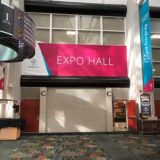
Expo Hall of the RootsTech
Expohall the day before
VIP Dinner – Harald Heimbach with Jenny Baker from the UK and David E. Rencher from Familiysearch
Dr. Rolf Sutter, David E. Rencher, Richard Charles Frederick Baker, Jenny Baker
Harald Heimbach and Dr. Rolf Sutter were also allowed to attend this event. Previously, they had a tour through Salt Lake City and visited the Salt Lake Temple, the Conference Center and the Joseph Smith Building.
Salt Lake City – Joseph Smith Building
Conference Center Salt Lake City
Salt Lake City
Salt Lake City Tour – The Salt Lake Temple
Salt Lake City
Salt Lake Temple
Historical Family Library in Salt Lake City
Salt Lake Temple
A special highlight for both was the visit to the Historical Family Library, which is very important for Pro Heraldica’s research.
Historical Family Library in Salt Lake City
Historical Family Library in Salt Lake City
Historical Family Library in Salt Lake City
Yesterday there were the first lectures. This Thursday, the lecture will be followed by Dr. Rolf Sutter.
https://pro-heraldica.de/wp-content/uploads/2018/03/1.-Tag-Rootstech-Rootstech-Salt-Lake-City-2018-33.jpg600800Dr. Harald Heimbachhttps://pro-heraldica.de/wp-content/uploads/2018/07/Logo_156-hoch.pngDr. Harald Heimbach2018-03-01 09:41:452020-09-16 10:19:16Opening Ceremony, VIP Dinner and 1st Day RootsTech 2018
Today this year’s RootsTech starts in Salt Lake City, Utah. By March 3rd, more than 13,000 conference attendees are expected at the largest genealogy and family history conference held in North America.
The RootsTech opens its doors this year for the eighth time. The first RootsTech was held in February 2011, drawing around 3,000 people. In 2013,it drew 6,700 registered attendees and over 13,600 remote attendees. Nearly 13,000 attended the 2014 RootsTech Conference in person, with over 100,000 remote participants. Once again this year, people who are not present on site will have the opportunity to follow up on some lectures in the livestream at https://www.rootstech.org/
Lecture by Dr. Rolf Sutter
In 2015, our former head of research Dr. Rolf Sutter has given a lecture entitled „The Art of Contemporary Heraldry“ together with Petra Heimbach.
This year our CEO Harald Heimbach and Dr. Rolf Sutter travelled to Salt Lake City to join the conference at the Salt Palace. We are looking forward to hearing what we get from Utah in the next few days.
Am Wochenende kehrten Dr. Rolf Sutter und ich mit vielen neuen Eindrücken von der RootsTech 2018 aus Salt Lake City zurück.
This year I travelled to this event for the first time. That’s why it was the size of the show that really impressed me. During the congress, there was a total of 320 lectures, always 20 lectures at the same time, from which one could choose. In total, more than 30,000 people visited the RootsTech in these 4 days. But I was also impressed by the importance of family research in the USA, the technical possibilities and the enthusiasm of the people for our topic. This is all very fascinating for me.
Events for invited guests
Networking has a high priority at RootsTech. On the eve of the opening day, Dr. Sutter and I were invited to the media dinner. There were also other events for invited guests. On Friday morning we followed an invitation to the VIP breakfast. There we had the opportunity to sit at the table with Steven T. Rockwood (President and CEO FamilySearch International) and exchange views with him and other leaders of the large family research companys.
Technical developments
Also in terms of Technology, the industry in the US is felt to be much further than we are in Europe. Thus, there was a separate hall at the fair only for companies offering technology solutions around the topic of family research. In a conference app, visitors were able to find everything they needed to know about RootsTech – the app took them to the workshops, showed who was in the exhibition hall and much more. There was even a list of participants in the app, with the help of which participants could connect and find. It also provided information about the keynote speakers, the restaurants and all the lectures and happenings of the day.
DNA analysis
Another big topic was DNA analysis. Large vendors had special RootsTech offers for test kits that they can use to test their DNA. It is very easy to make this test: Since our DNA is in all cells of our body, some saliva on a cotton swab is enough to determine it. In fact, a lot has happened in recent years in the field of DNA analysis in family research.
There are already numerous success stories in which relatives could be located through this process. DNA analysis is particularly useful when written evidence of origin has been destroyed or can no longer be traced back to adoptions.
Of course we want to incorporate all these impressions into our work here in Germany as well. RootsTech was a very inspiring event from which many new ideas could develop in the near future. Finally, I would like to thank the generous Mormon Church invitation, especially from our friends David Rencher, Chief Genealogical Officer, FamilySearch, and Michael J. Hall, Deputy Chief Genealogical Officer, FamilySearch.
https://pro-heraldica.de/wp-content/uploads/2018/03/Rootstech-2018-Steve-Rockwood-Harald-Heimbach.jpg20161512Dr. Harald Heimbachhttps://pro-heraldica.de/wp-content/uploads/2018/07/Logo_156-hoch.pngDr. Harald Heimbach2018-02-28 09:35:212020-09-16 10:19:55RootsTech 2018 – Review
At Pro Heraldica, every genealogical research and coat of arms commissioning is unique. No story and no coat of arms are alike. And as in almost no other area, our employees have a very private insight into the lives of our clients. A trust-based relationship is therefore indispensable in our work. In addition, our genealogists have a great deal of passion for exploring family histories and dealing with them. This often results in a very close connection between us and our clients. Last week, our CEO Harald Heimbach received a call from Hans-Joachim Frohne, who absolutely wanted to personally thank him for the cooperation. In a subsequent e-mail, he described the way Pro Heraldica works as follows:
Dear Mr. Heimbach,
I would like to live up to your wish under the impression of the very nice conversation: my comments on this ->
In discussions with my conversational partners, acquaintances and friends, I do not miss an opportunity to talk about our crest and family history. Our completed work makes me proud and happy at the same time – a sense of inner peace and also the feeling of having taken a good step for the upcoming generation.
And all of this has come about with Pro Heraldica’s employees over many years of collaboration – our family history research and then the design of the coat of arms.
Again and again, it was a great deal to work with Pro Heraldica’s employees to create our family research and bring it to life.
Maybe it is not the cheapest version of family research, but worth every cent cause of the excellent collaboration. You can sense in every way that the Pro Heraldica employees are not concerned with the client’s “customer” money, but with their concerns. Over the many years of joint research of our family history, we have grown together „almost as if to a family“ and that is a defining impression.
The task becomes the passion of the individual
Over and over again I feel how the task becomes to passion of the individual, and that is unique in working with Pro Heraldica!
I firmly believe that the spoken word is always dependent on the previous or current conversation and just like the shot down arrow, which will not come back again.
Pro Heraldica is not just a company that helps with family research and design, but rather a partner in the matter itself!
I wish you all the best and hope you will always have satisfied customers like me.
https://pro-heraldica.de/wp-content/uploads/2018/02/Frohne-EHerold.jpg300300Alexandra Scheiderbauerhttps://pro-heraldica.de/wp-content/uploads/2018/07/Logo_156-hoch.pngAlexandra Scheiderbauer2018-02-22 09:45:062020-09-16 10:18:55When the profession of family research becomes a passion
John F. Kennedy would turn 100 on May 29th 2017. He was born in 1917 in Brooklyn, Massachusetts and died in 1963 by a number of gunshots when he was driving in a convertible car through the city of Dallas. John F. Kennedy was the 35th president of the US from 1961 – 1963. Up to present his speech on the occasion of the 15th anniversary of the Berlin airlift in front of the city hall of Schoeneberg is unforgotten. His sentence „Ich bin ein Berliner“, meanwhile is very legendary around the world.
US-Presidents with Coat of Arms
John F. Kennedy was not the first president of the US, bearing a family Coat of Arms. Many of his counterparts also had one. Bill Clinton, Ronald Reagan, Lyndon Johnson, Dwight D. Eisenhower or Franklin D. Roosevelt are just some of them. The link below shows a detailed list of all US-Presidents bearing a Coat of Arms:
Shield: Sable, three helmets in profile Or within a bordure per saltire Gules and Ermine.
Crest: between two olive branches a cubit sinister arm in armor erect, the hand holding a sheaf of four arrows, points upward, all proper.
The design of Kennedys‘ Coat of Arms is a modified combination of the emblems which were historically assigned to the Irish names Kennedy and Fitzgerald, the paternal and maternal lines of Kennedy.
The main field of the schield, black with three golden helmets lean against the Coat of Arms of O’Kennedy from Ormonde, which shows three silver helmets. The border of the main shield is reminiscent of the Coat of Arms of Fitzgerald, the Earl of Desmond.
https://pro-heraldica.de/wp-content/uploads/2017/06/Wappen-John-F.-Kennedy.jpg600403Sultan Basarhttps://pro-heraldica.de/wp-content/uploads/2018/07/Logo_156-hoch.pngSultan Basar2017-06-14 09:48:512020-09-16 10:18:44The Coat of Arms of John F. Kennedy
Often people ask: Why should someone research his ancestry? Why is it interesting for someone to know ancestors who lived 300 or 400 years ago? What are the motives for a genealogy? Today we want to tell you some basics about the genealogy in other terms the family research.
Identity, rooting and the sense for traditions
The most interesting thing about the question of one’s own origin is, that it bothers almost everyone. After eroticism, family history is the most popular keyword in the search engine. There is a primary need of people to experience where we are coming from. For some people this need is stronger for others less strongly. But the knowledge about the own family history builds identity, rooting and a sense for traditions. Especially our generation is living in a time where it is still possible to interview contemporary witnesses, who experienced the war or the post-war years.
Research at living relatives
As you can imagine, unfortunately, this biological window soon will be closed. In addition, there is also the problem that our parents and grandparents did not want to report about the times of the war, therefore most of them never talked about their past. This situation was the same for our director Harald Heimbach. In fact, exactly this thrilled him to start a family research. But how to start such a big project? Well, actually by asking around and interviewing the family. Is there an old aunt, or somebody from the generation of the parents/grandparents who can tell you interesting facts?
Making the family history alive and tangible
Pro Heraldica is able to research a lot. But we can only research information that has been written down someday and that is still available in any archive. Oral traditions and histories make family chronicles more interesting. This is why the first step of a family research always should be talking to (older) family members, reviewing photo albums and labeling all photos. Often clients submit great photos without knowing the persons on them. In such cases these photos are not usable anymore. Sure, they still have an emotional value, since you do not know the persons they also do not tell any story. Next you should check any kind of old document.
Search for family passports and family registers
Often, families still have family passports, family registers and other records. Most of the time you are not aware about it because they are not really present in the everyday life. Just ask for them, they are worth a mint. This way at least you will have information about your parents, grandparents and maybe great-grandparents and so you already made it to the 19th century in your family history on your own!
We start where your knowledge ends
Our research always starts where the knowledge of the respective family ends. If your information end around 1890, so we start around 1890. If it ends with your gradnparents, so we start there! So, what are the next steps? Now, we should clear your goal of the family research. What should be the output of the genealogy?
In genealogy we distinguish between the pedigree chart and the family tree. Whereas the youngest generations build the treetop for the family tree they are found at the very bottom on a pedigree chart. On a family tree the progenitor and progenitrix are the family trunk, the direct ancestors. You can find the siblings for each on the left and right side. The older ones at the left side and the younger siblings of a progenitor on the right. This is also why there is no blank form for a family tree.
Scheme of a family tree
The family name as a thread
All persons on a family tree have one thing in common: The family name. Either they were born with the name or they married-in. For the most cases the family tree is the entry of a genealogy since people identify themselves with their family names and you possibly sign hundreds of documents with it a day. Of course, this is a really patriarchal way of contemplating your family history.
Pedigree Chart, the widest kind of family research
Since everyone has two biological producers the number of people per each generation is doubled on a pedigree chart. You have two parents, four grandparents, eight great-grandparents, 16, 32, 64,128 and so on. Here the name line is just one small line, the other lines are the genetic ancestors. As you see the pedigree chart is the widest kind of a family research. It is also called the queen of genealogy.
Scheme of a pedigree chart
Widely dispersed family members
It is not uncommon, that a part of a family history takes place in a completely other region than other parts. In such cases we are researching parallel with 4, 5 or even 6 employees. So, it is very important to know your personal objective from the beginning.
Creating the family chronicle
After a family history is researched, it is also important and useful to shape the results. Therefore, after each family research we create a very individual family chronicle with two volumes. The first volume, the chronicle itself is about the family history in a chronological order as it took place in regional history. So, the family history gets perceptible, comprehensible and especially exciting. The second part, the documentation therefore, is a very important part. Every scientific work lives from the reproduction of its sources. We emphasize to make original documents accessible for you. So, we put copies and translations into the documentation for you to prove all our researched results. This way the chronicle makes sense and you can pass it to next generations and also update it. It is possible to book the chronicle in different and individual ways; we always accommodate the wishes of our customers.
https://pro-heraldica.de/wp-content/uploads/2015/09/Fotolia_17324925_S.jpg600800Sultan Basarhttps://pro-heraldica.de/wp-content/uploads/2018/07/Logo_156-hoch.pngSultan Basar2017-05-05 09:56:272020-09-25 11:48:59Why do you do genealogy?
In our blog we often present German and European heraldry. Today we want to show you some Japanese Coat of Arms. They are called mon and the translation of it is symbol or emblem. As the western and European crests, knights originally used mons at the battlefield to identify foe and friend. Today it is a symbol for families and their belonging.
Commonalities of Mons and Western Crests
Mons are intergenerational symbols of families and several rules determine hwo to pass
Either a family accepts a mon or someone grants it
In the Heian-period generally the nobility had mons, from the Edo-era on however, also the commoners
There are also talking mons depicting the meaning of the family’s surname
You cannot bear a Coat of Arms unlawfully
Differences of Mons and Western Crests
Contrary to the complex design of western Coat of Arms, mons are very simple. Mostly it is a circle with an animal or a plant.
Japanese mons do not have crests since the samurai did not bear them to keep both hands free. Therefore, they painted the mon on their helmet, cape, breastplate, saddle or horse blanket.
Often mons are not unique. This results from the simplicity of Japanese crests. Only little details help to distinguish different mons.
In Japan people can also bear universal Coat of Arms. Their name is Tori-mon or Muda-mon. They are not designed for a special person himself.
Spouses do not bear the same mon. The wife always bears the mon of her male tribe.
Mons are monochromatic whereas the color is not that much relevant. It is possible to find the same crest in different colors.
*Source: http://www.dr-bernhard-peter.de/Heraldik/seiten/mon.htm
Kikumon – the Japanese Family Coat of Arms of the emperor
The kikumon is the most popular mon. The Japanese emperor and his family bear this mon and it symbolizes the sovereignty of the Japanese state. It has the shape of a Chrysanthemum with 16 blossoms. Kikumon means Coat of Arms of the Chrysanthemum in Japanese. The Meiji Constitution earmarked the kikumon for the sole use of the Tennō. This is why members of the imperial family used a slightly changed version of the original kikumon. Even though it is not officially the imperial seal of Japan, largely instituions use it at such. You can even see it on the Japanese passport.
Perhaps each of you has ever seen the mon below. It is the logo of the automobile manufacturer Mitsubishi. The name comes from the Japanese words mitsu(=three) and hishi(=water chestnut/rhombus), so literally it means three rhombuses.
Often the h in the middle is pronounced as a b in Japan. This is why the combination from mitsu and hishi is spelled Mitsubishi.
The founder of Mitsubishi, Yataro Iwasaki, chose the Mon for his company. It is formed from the three leaves of the Coat of Arms of the Tosa-Clan (his first employer) and the three layered rhombus from the mon of the Iwasaki-family.
As in previous years RootsTech took place again in the United States in Salt Lake City, Utah. With more than 12,000 conference participants it is the greatest event for genealogy of the US and it was already the seventh time this year. It was also possible to follow some of the sessions via livestream and the videos are still available at rootstech.org. In 2015 Pro Heraldica was also represent there with interesting speeches. Petra Heimbach and Dr. Rolf Sutter lectured about “The Art of Contemporary Heraldry”.
Accompanying the RootsTech its fair had more than 200 exhibitors. Round about 12,000 participants from over 40 countries visited the event in the Salt Palace Convention Center in Salt Lake City. On Family Day the number of visitors reached even 30,000.
The exhibition hall offered several zones. Firstly, the Discovery Zone to discover anything about genealogy. From interesting facts to interactive elements everything was dedicated to the search of ones’ ancestors.
The Thec Zone in turn presented new technologies and products regarding the family research. The participants had the chance to take individual interviews with professional genealogists.
The video below shows a small review and it will be clear very fast how important genealogy is for the visitors of the RootsTech.
You are currently viewing a placeholder content from Default. To access the actual content, click the button below. Please note that doing so will share data with third-party providers.
In a few days it is Christmas. Of all festivals of the year, Christmas is the most powerful one. Perhaps because it is celebrated during a cold and dark time and all the lights and Christmas decorations are breaking through this darkness. Often the time before Christmas is really hectic, so we enjoy the contemplative mood and the silence of Christmas. But maybe primary it is because all of us has his own and personal memories of Christmas.
Especially during this time such memories are exchanged within the family. And new memories are added.
Memories, that we will eventually write down for you and your ancestors one day. Such memories are an essential part of your personal family history.
Today, on behalf of my family and the entire Pro Heraldica team, I would like to wish you a merry Christmas! I wish you peace, time, serenity and relaxation. For 2017 I wish you all the best, professional success and personal satisfaction!
You are currently viewing a placeholder content from Turnstile. To access the actual content, click the button below. Please note that doing so will share data with third-party providers.
You are currently viewing a placeholder content from Vimeo. To access the actual content, click the button below. Please note that doing so will share data with third-party providers.
You are currently viewing a placeholder content from YouTube. To access the actual content, click the button below. Please note that doing so will share data with third-party providers.
You are currently viewing a placeholder content from Instagram. To access the actual content, click the button below. Please note that doing so will share data with third-party providers.
You are currently viewing a placeholder content from Instagram. To access the actual content, click the button below. Please note that doing so will share data with third-party providers.
You are currently viewing a placeholder content from X. To access the actual content, click the button below. Please note that doing so will share data with third-party providers.













 Am Wochenende kehrten Dr. Rolf Sutter und ich mit vielen neuen Eindrücken von der RootsTech 2018 aus Salt Lake City zurück.
 Networking has a high priority at RootsTech. On the eve of the opening day, Dr. Sutter and I were invited to the media dinner. There were also other events for invited guests. On Friday morning we followed an invitation to the VIP breakfast. There we had the opportunity to sit at the table with Steven T. Rockwood (President and CEO FamilySearch International) and exchange views with him and other leaders of the large family research companys.
 There are already numerous success stories in which relatives could be located through this process. DNA analysis is particularly useful when written evidence of origin has been destroyed or can no longer be traced back to adoptions.


 war, therefore most of them never talked about their past. This situation was the same for our director Harald Heimbach. In fact, exactly this thrilled him to start a family research. But how to start such a big project? Well, actually by asking around and interviewing the family. Is there an old aunt, or somebody from the generation of the parents/grandparents who can tell you interesting facts?


 As in previous years RootsTech took place again in the United States in Salt Lake City, Utah. With more than 12,000 conference participants it is the greatest event for genealogy of the US and it was already the seventh time this year. It was also possible to follow some of the sessions via livestream and the videos are still available at rootstech.org. In 2015 Pro Heraldica was also represent there with interesting speeches. Petra Heimbach and Dr. Rolf Sutter lectured about “The Art of Contemporary Heraldry”.
 In a few days it is Christmas. Of all festivals of the year, Christmas is the most powerful one. Perhaps because it is celebrated during a cold and dark time and all the lights and Christmas decorations are breaking through this darkness. Often the time before Christmas is really hectic, so we enjoy the contemplative mood and the silence of Christmas. But maybe primary it is because all of us has his own and personal memories of Christmas.
