
The Pedigree Chart
The Pedigree Chart: Research into the genetic code


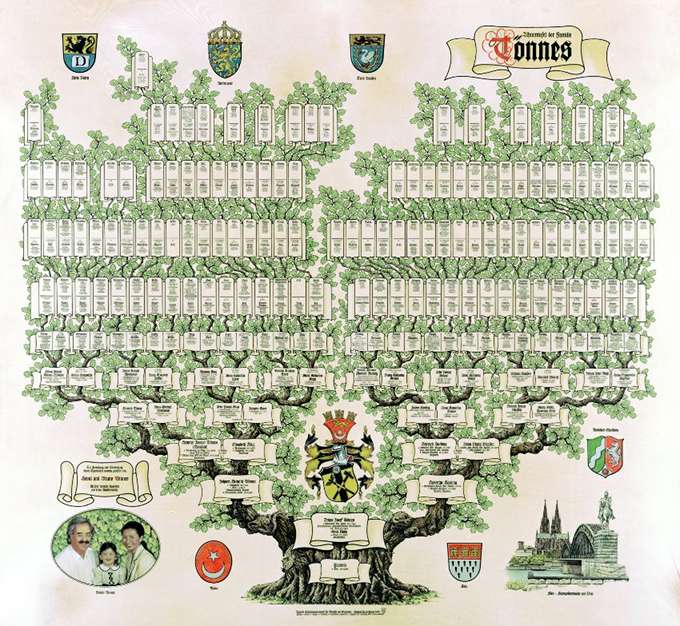
When starting with family history research, one must first decide on a research goal: family tree or pedigree chart. There are a few fundamental differences between the two research approaches. For instance, more members are added exponentially to each generation in a pedigree chart because their parent pairs are always researched. Family tree research focuses only on researching the male ancestors carrying your name.

Pedigree uncovers a person’s ancestors
A pedigree enables a person to unwrap their ancestral past fully. The separate sex of ancestors in genealogy is presented as males (blue) and females (red). This helps to demonstrate the direct bloodline from whom an individual is in relation to his/her past as each subject’s parents are represented in the chart.
Mother and father for every person
As previously stated, pedigree charts are exclusively dedicated to the parents of each individual. After each parent is successfully identified from their ancestor, they are added to the next generation in the pedigree, thus, doubling the member quantity with each newly added generation. With the exception of the test subject, the male ancestors receive even ordinal numbers in all generations, whereas the female ancestors receive odd numbers. As a pedigree focuses mainly on each direct descendant’s mother and father, siblings are not recorded in the chart.
Ancestral data for each individual
On the chart, men are traditionally illustrated in blue and women in red. The root is always identified by the number “1” from which women are assigned odd numbers while males are assigned even.
Details and documents which were found during the research are incorporated in your Family Chronicle. The individually written volumes contain facts and figures set in the context of the everyday experiences of your ancestor’s lives. It is a treasure that makes your family history tangible and brings each of their stories to life.
For each researched ancestor, we provide the following details, as the sources permit:
- Name
- Place and date of birth and baptism/christening
- Place and date of marriage
- Profession
- Date of death and burial location
- Interesting facts and stories when found
A multi-volume family chronicle can take up to approximately 6 months to complete, however, its summarized style ties a family’s true past into one extensive analysis. Each research project and its approach can be uniquely customized to fit the client’s wishes and desires.
Contact us to learn more about how the process begins.
Ancestral Peaks & Gaps
Occasionally, our research team will come across a lineage particularly rich in branches. This is an indicator that research on a family’s history had been successfully undertaken during a period of time. Such an „ancestral peak“ is often the result of a marriage between members of the middle-class into a family of nobility. This results in the discovery of extensive qualitative information regarding the genealogical characteristics of a family and, in return, increase the research’s accuracy.
On the other hand, a gap in a chart does not automatically mean the ancestors are lost. This may be an indication that there is a common ancestor at two or even more places. When two ancestors share a common great-grandmother, this leads to the appearance of a minor “gap” in the family’s history. In this case, one ancestor can belong to two members of the family.
Are you interested to find out if your family possesses such Ancestral peaks or gaps? Feel free to contact us!
This post is also available in: