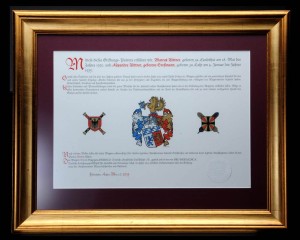
Commissioning a coat of arms

Once a new coat of arms is designed, we undergo a so-called coat of arms endowment process. These procedures are set forth when no historical reference of a coat of arms is found for a respective family or an existing coat’s authorization is inoperable. The list of requirements for an existing family’s coat of arms to be accepted can be found here.

Would you like to know if your family is permitted to either take on an existing coat of arms or is allowed to develop a new one? Then please feel free to contact us Here.

If you do choose to develop a new coat of arms, there are three main phases of the coat of arms endowment process:

You are currently viewing a placeholder content from Default. To access the actual content, click the button below. Please note that doing so will share data with third-party providers.

More Information

The Three Steps to a New Family Coat of Arms

Layout of Design

Once you have decided to pursue the development of your family coat of arms, will we begin by formulating a heraldry layout design. With such a layout there are two sides to take into account: one is the acknowledgment of the preferences and perceptions of the regarded family, and the other is the correct implementation of the rules of heraldry. The beauty of it all is to have developed a coat of arms that highlights both sides‘ best. Our well-informed heraldic experts have developed a knowledgeable understanding of these heraldic rules and use them to create every new family coat of arms. This acknowledgment is crucial in guaranteeing the ability to register your family coat of arms. At the beginning of this process, however, we search for substances that provide a suitable association with your family.

The following points can be considered in the design:

The family name:

 It is an old tradition to design a canting coat of arms. These are the coat of arms that have their family names reflected in their design. This can be done using specific geometric shapes and divisions that integrate one’s initials within the coat’s framework. While many events may occur within a Family’s history, the name and its associated definition remain constant. In this sense, it is useful to perform an etymological interpretation of the name.

Professional Traditions:

Here you can display professions that have been practiced for generations, current professions, or practically any entrepreneurial Situation.

Regional Context:

In Heraldry, we have the opportunity to assimilate elements of the urban and national coat of arms to uphold the origin of the family. The same concept can also be applied to the coat’s use of color.

Mentality and attitude to life:
This can be religious or philosophic elements.

Features of the commissioning family:
In Heraldry, many animals or combinations of animals with mythical creatures are used in expressing uniques features of the family’s background.

Characteristics of the family:
These range from special events or stories or affiliation to certain clubs, associations, lodges, or alliances that could be mentioned within the coat’s design.

Beyond this, it is important to contemplate the creative aspects of commissioning a coat of arms. This includes the choice of colors, the positioning (oblique or straight), and the choice of shield and mantling.

We have included a checklist to make the commissioning of your coat of arms as easy as possible. Click here to get started on your checklist.

2. Documentation

After you have successfully commissioned the coat of arms, it is necessary to keep records of the accredited task for generations to follow. Within these records, we provide a so-called blazon of the coat of arms. This gives a professional description of the choice of elements and figures used within the coat’s design. Also, a photographed copy should be made to start the publication and registration process of the coat of arms. This will all be prepared and assessed by our helpful staff.

3. Registration

For a coat of arms to sustain through the following generations and have legal validity, it is necessary to publish and register its commission by an approved Heraldic Register. Every coat of arms created by Pro Heraldica is published every two years in the german Heraldic register and is shown in all large libraries and archives throughout Germany. For more information on the registration process, please Click Here.

Examples of Commissioned Coat of Arms

No coat of arms is like another, each of it is unique. Sometimes the familys that make a commission write a blogposting in our blog.

1) Coat of Arms Reisinger

A nice example of a pleased comissioner of a coat of arms is the Blogpost – Christian Reisinger´s coat of Arms.

2) Coat of Arms Noah’s Ark

Something very special for us is the coat of arms of a zoo owner, in which Noah’s Ark has been used in the coat of arms to symbolize the profession of the comissioner of the coat of arms.

3) Coat of Arms – Flores Family

The blazon which describes the Flores coats of arms clearly and completely is as follows:

Arms: Azure with wavy base argent in three rows five fleur de lis argent (2,1,2) and four roundels or (1,2,1)

Crest: A wyvern or blazing fire gules

Mantling: azure-argent-azure-or.

This post is also available in: German