
Tinctures of Coats of Arms
In heraldry colors are tinctures. Primarily they help to contrast the Coat of Arms. This is why each Coat of Arms has at least two tinctures, whereas one needs to be metallic.
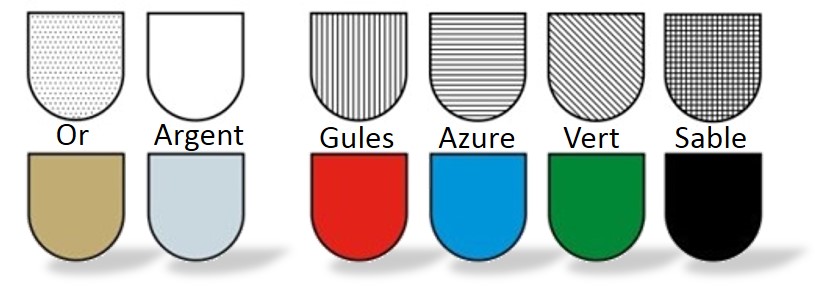
In general heraldry distinguishes between six different tinctures. These are gules (red), azure (blue), vert (green), sable (black) and the two metals or (gold) and argent (silver). Since it is hard to depict silver and gold in a truly shade, white and yellow are representing this metallic tinctures in heraldry. Sometimes clerical Coat of Arms also contain purple. Natural colors like brown are just tolerated when there is a special reason for it.
Rules of Tincturing
- The tinctures need to be counter-colored. This means, beside a metallic tincture again a metallic one is not allowed. The correct combination therefore is: Metallic tincture, colored tincture aso. Only details of symbols or several shapes that help to divide the shield can be exceptions.
- The colors of all tinctures are consistently strong. Serious heraldry does not allow to shade the tinctures by using a dark green or light blue.
- It is quite allowed to color any symbol that is on your Coat of Arms, even when the color is unusual. Therefore, you will see Coat of Arms with blue lions or a green city walls. The tincture does not change the meaning of the symbols at all.
- There is a historic ranking of the tinctures. It developed over time and represents their frequencies of appearance in the history of heraldry. Therefore, it also shows the appreciation of each tincture. Or (gold) forms the first place whereas sable (black) appears at the back. The photo below demonstrates this ranking. Whenever a Coat of Arms is described by its tincture in a text you should obey this ranking and list the tinctures after it.

Symbolism of Tinctures
There are a lot of texts reporting about this topic. In fact, such interpretations of values, meanings and relevance are just speculations. Strictly, these interpretations cannot be proved in the science of heraldry. From the beginning heralds choose the colors depending to the Coat of Arms design. They achieve the contrasting by the limit of the tinctures what ensures recognizability from a high distance.
A universal interpretation of tinctures regarding special imaginations of values never was important for the choice of the tinctures. However, very old guidelines are listing such interpretations. When creating historic and serious Coat of Arms this was never an issue. In the course of time heraldry also had some special colors like brown or orange. Today they are not accepted as classical tinctures.
Furs
Compared to colors, furs have a special position in heraldry. Some heralds even count furs as colors. They originate from the early period of heraldry and are only used in special cases today.
The names of the furs are remembering the language of the Near East back in the time of crusades somehow. Therefore, Vair – a pattern like a real fur – relates to the huge trade relations back in the Middle Ages. One characteristic also reminds to military origin of Coats of Arms. Blazons (description of the Coat of Arms in technical language) are describing the Coat of Arms from the perspective of the person who is bearing the crest. Therefore, anything what is on the right side for him, for the person on the opposite side is left and vice versa.

Hatches
As mentioned before, the main feature of heraldry are the colors. But sometimes it is not possible to depict the tinctures as colors. Primarily this is the case for signets. Since a signet is not able to reflect the colors on a Coat of Arms each tincture has a hatching code. Before doing so, the initial of the color was placed on the several field to show them on signets. Due to differences in languages this was not the best solution.
This post is also available in: