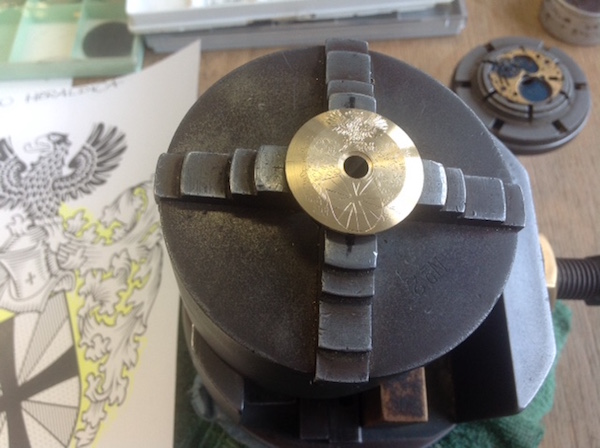
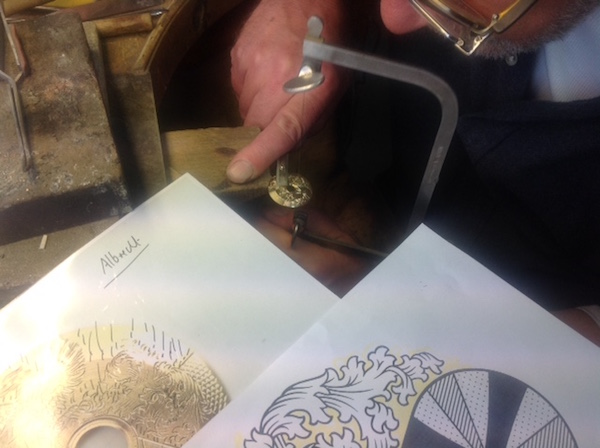
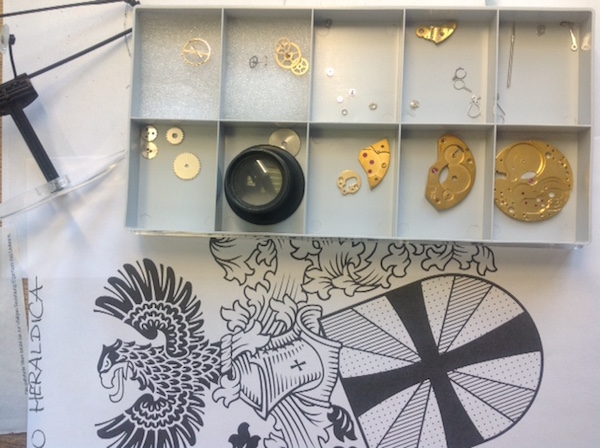
We have received word from our watchmaker concerning the progress of your Pro Heraldica watch. As always, we are very excited to have a look at the pictures by Jochen Benzinger. Every single picture tells us how sophisticated it is to manufacture such a watch and that every single one of them is a unique piece of jewelry. Today’s picture gallery focuses on the golden rotor. You can see that in a first stept the coat of arms is hand-engraved on the rotor and afterward the rotor is skeletonized. In the course of this process some parts of the rotor are going to be remove with a goldsmith’s saw, otherwise we could not see through to the mechanical clockwork later.
When you choose us for having such a watch made, you can receive your personal picture documentation that shows you how your very own piece has been produced. This is not only a great way of staying up-to-date with the watchmaker and what part he is currently working on, but it is also going to be a great memory about how this very special piece of jewelry has been manufactured.
Operational drawing of the rotor for a Pro Heraldica „Chrono-Zeitmaschine“
Raw golden part (750/000) of a rotor for a Pro Heraldica „Chrono-Zeitmaschine“ with layed out coat of arms. This part will receive hand-engravings and will be skeletonized by hand.
The coat of arms is engraved on the golden rotor.
The golden rotor.
With a very acurate saw the delicate structures of the coat of arms are cut out.
The golden rotor is skeletonized with a gold saw.
Afterwards the rotor is skeletonized by hand with a goldsmith’s saw.
https://pro-heraldica.de/wp-content/uploads/2016/05/Step-11-Wappenrotor.jpg478640Alexandra Scheiderbauerhttps://pro-heraldica.de/wp-content/uploads/2018/07/Logo_156-hoch.pngAlexandra Scheiderbauer2016-05-24 14:47:192020-09-15 16:59:24How a Pro Heraldica Watch Is Made – Part II
In a number of blog posts we have already been emphasizing that our Pro Heraldica <a href=“http://proheraldica.com/fine-arts/“ target=“_blank“ rel=“noopener“>Fine Arts products</a> are handcrafted. Now, it is time to have a look behind the scenes and look over the manufacturer’s shoulder. Today, we would like to show you how a <a href=“http://proheraldica.com/fine-arts/jewelry/“ target=“_blank“ rel=“noopener“>Pro Heraldica Chronometer</a> is made. For that purpose we put together a collection of pictures that illustrate beautifully how all those tiny parts are assembled by caring hands.
Currently, our watchmaker Jochen Benzinger is working simultaneously on four differents models. From time to time, he grants us a glimpse at his work and shares his work progress with us by taking pictures of the different work steps. We gladly share them with you and invite you to enter the world of this century-old handicraft.
In part I of our series „How a Pro Heraldica Watch Is Made“ you can see for yourself what painstaking work is put in such an individual piece of jewelry:
First of all, the watchmaker Jochen Benzinger creates an operational drawing. This is the draft for a watch type „Full Skeleton floral black“.
This is our watchmaker Jochen Benzinger creating the draft for the clockwork.
Unassembled and unfinished parts for the manual wind of a Pro Heraldica „Regulateur“.
Upper and lower dial (unfinished) of sterling silver for Pro Heraldica „Subskription3“ – ready for the guilloches.
Balance wheel, escapement and escapement wheel for the Pro Heraldica „Regulateur“.
Raw golden part (750/000) of a rotor for a Pro Heraldica „Chrono-Zeitmaschine“ with layed out coat of arms. This part will receive hand-engravings and will be skeletonized by hand.
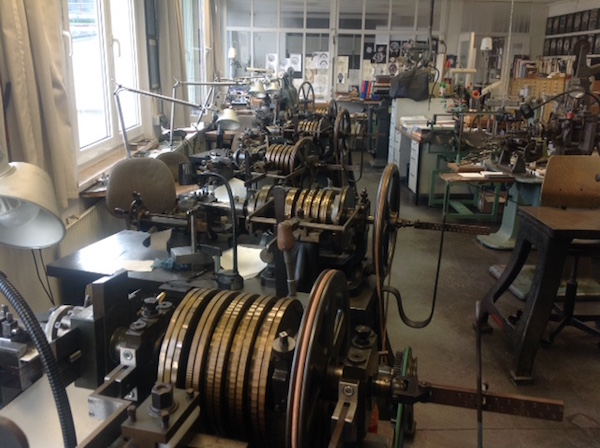
Guilloches machines – some are more than 100 years old.
Guilloches machine engrave the desired pattern on dials and clockworks. To produce guilloches it takes a lot of skill as the machine is very delicate.
That is the reason why only few people still know how to operate these machines from the 19th century.
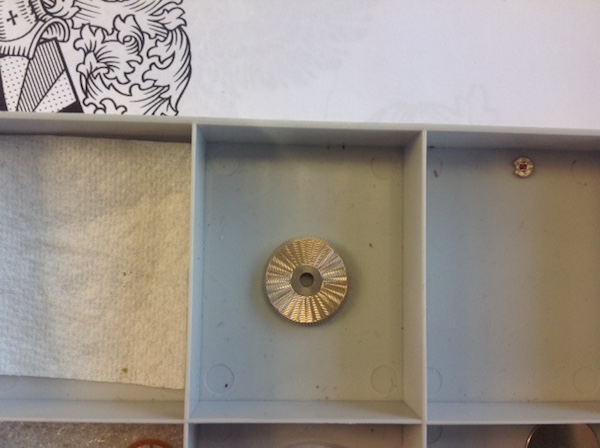
The sections to be skeletonized get their guilloches.
The sections to be skeletonized get their guilloches.
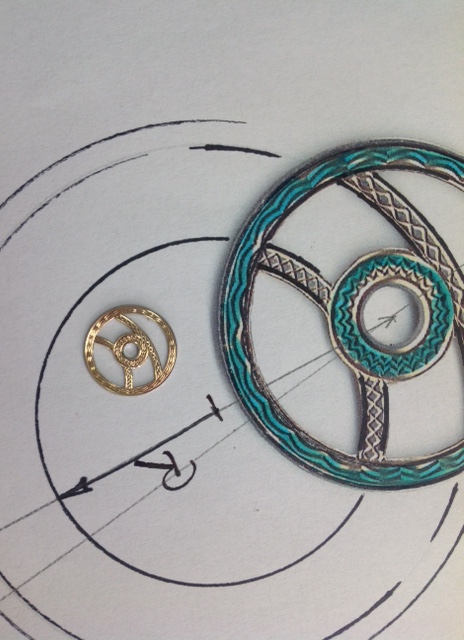
Paper draft vs. bridges and cocks with guilloches for the hand wind of the Pro Heraldica „Subkription3“.
Completed draft for the golden rotor in the shape of a coat of arms for the Pro Heraldica „Chrono-Zeitmaschine“.
Paper draft vs. complete skeletonized barrel lid with guilloches.
https://pro-heraldica.de/wp-content/uploads/2016/05/15-Einteilung-ornamentik-guillochiert-3-e1464081691413.jpg640478Alexandra Scheiderbauerhttps://pro-heraldica.de/wp-content/uploads/2018/07/Logo_156-hoch.pngAlexandra Scheiderbauer2016-05-11 14:42:012020-09-25 11:56:12How a Pro Heraldica Watch Is Made – Part I
When you start researching your family history, the most important thing you need is information. On the one hand, living relatives can, of course, provide you with that; on the other hand, you should look for old documents. Almost everyone has a pile of them at home. Said documents might be your own and you are keeping them because you are going to need them at some point in the future yourself. They might as well have been handed down to you from your ancestors. Perhaps you stumble upon them by accident when cleaning your attic.
How can you properly preserve these documents which will be useful one day for your family research? Here is a checklist that can help you keep your documents in good condition.
Protect Your Documents from Dirt
It is very important to keep your documents away from anything that could worsen their condition. Before you start, you need a pair of linen gloves, a dusting brush, and a sharp knife. Do not have beverages or food near the documents while cleaning them!
Sort the Wheat from the Chaff
For lack of space you may not be able to keep all of your documents for posternity or for your family research. That is why you should sort the wheat from the chaff, i.e. seperate more important documents from the ones which are not. You may have, for instance, more than just one copy of the same document. And typically, you will only need one in your archive.
Once you have made your selection, you can start with the actual work.
Examine Your Documents
Check your documents carefully for traces of mold, rust (from staples or paper clips), water spots or paper decay from improper folding. Sort out all documents that might need further care or treatment. That may be, for instance, all documents that have metal staples or paper clips.
Prepare and Repair
Carefully dust off your documents with a dusting brush. Afterwards, remove all staples and paper clips. If the documents show rust stains, remove them as far as possible with a special brush for rust. It might be necessary to „repair“ some of your documents. You can do smaller repairs yourself by using special glue that is based on fish glue and does not affect the paper. The best thing, however, is it to give damaged documents to professional archivists. Experienced archivists can even repair larger damages.
Archiving
If you want to store your documents using plastic sheet protectors, make sure that they do not contain any kind of softeners which can affect the paper. If you choose paper envelopes for that purpose, make sure they are acid-free.
If you follow these simple rules, you are well prepared for the day when you begin your family research. Your documents will be ready and in good shape.
https://pro-heraldica.de/wp-content/uploads/2016/04/Archivierung-Staubpinsel.jpg531800Alexandra Scheiderbauerhttps://pro-heraldica.de/wp-content/uploads/2018/07/Logo_156-hoch.pngAlexandra Scheiderbauer2016-04-28 16:28:362020-09-15 16:58:42How To Preserve Your Documents
A signet ring is one of the most beautiful ways to carry your coat of arms always at your side.
Some families have even established certain rituals for passing on their coat of arms and the family traditions associated with it. Not long ago, we received a photograph from the Fuhr family. It shows the family’s letters patent and on it each family member has place their hand. All family members, i.e. mother, father and their three daughters, wear a signet ring with their family’s coat of arms.
All three daughters have been given their signet ring on their 25th birthday as a present. The youngest daughter has just celebrated hers quite recently. As a result, all family members are wearing their signet rings now.
We are always happy when pictures like the one below are sent to us. It illustrates quite well the significance of these pieces of jewlery and the value the families assign to them.
Many thanks to the Fuhr family for giving the permission to publish this photo in our blog. We wish you lots of joy with your very special jewelry!
https://pro-heraldica.de/wp-content/uploads/2014/09/Familie-Fuhr-Siegelringe-e1410168257522.jpg398473Alexandra Scheiderbauerhttps://pro-heraldica.de/wp-content/uploads/2018/07/Logo_156-hoch.pngAlexandra Scheiderbauer2016-04-08 14:16:102020-09-15 17:00:53Signet Ring as Birthday Present
Source: “Bismarck. Des eisernen Kanzlers Leben in annähernd 200 seltenen Bildern nebst einer Einführung“, released by Walter Stein in the year of Bismarck’s 100th birthday.
Today is the birthday of Otto von Bismarck, the „Iron Chancellor“ who served as German Chancellor from 1871 to 1890.
(* April 1, 1815 in Schönhausen, Germany; † Juli 30, 1898 in Friedrichsruh near Hamburg, Germany)
He was probably Germany’s most important politician in the 19th century.
Hardly any politician before Otto von Bismarck had influenced the more recent history of Germany. He started his political career as a representative for the Junkers (=squires) in conservative circles. Later he became a diplomat and finally the Minister President of Prussia. He then—because of his origin—fought for the supremacy of the monarchy against liberal political forces.
(Source: https://en.wikipedia.org/wiki/Otto_von_Bismarck).
After the founding of the German Empire in 1871, Otto von Bismarck was appointed first Imperial Chancellor (Reichskanzler) of the German Empire. He was chancellor till 1890.
A quote by Emperor Wilhelm I illustrates quite well the position of Otto von Bismarck: „It is not always easy to be the emperor under this chancellor“
Not long ago, we reported in our German blog how dearly the Bismarck family keeps their traditions and their family ties, today. When a new family member is born or on the occasion of a wedding, the family has silver napkin rings or silver shot glasses manufactured. Also for other occassions, the Bismarck family draws on PRO HERALDICA’s Fine-Arts collection.
Here is an excerpt from the Allgemeine Deutsche Wappenrolle (German Roll of Arms) depicting the von Bismarck coat of arms:
von Bismarck
from Stendal/Sachsen-Anhalt
Azure a clover leaf or appointed with oak leaves argent in pall reversed. On the crowned helmet with mantling azure-argent a crown or between two open buffalo horns argent-azure per fess counter-changed.
In the picture below you can see the Schönhauser line of the Bismarck family. The chart shows that Bernhard Friedrich Alexander Ferdinand Roman is a brother of Otto von Bismarck.
aus: Jochen Thies, „Die Bismarcks – Eine deutsche Dynastie“
On March, 25th Elton John was born in Pinner, Middlessex, Greater London. He was Born as Reginald Kenneth Dwight. Elton John changed this name via Deed poll.
In 1995 Elton John was appointed a Commander of the Order of the British Empire (CBE) by Queen Elizabeth II. On February, 24th 1998 Elton John was knighted by Queen Elizabeth II. He can call himself Sir Elton John, CBE.
Sir Elton John’s coat of arms was granted to him in 1987.
Blazon
Per saltire gules and or, in fess two pellets pierced and in pale as many plates also pierced, on a chief argent issuant in chief seven pallets retrait two three and two sable.
The chief represents the keys of a piano keyboard the pierced roundels represent records and CDs. Red and gold are apparently the colours of Watford Football Club of which Elton John was Chairman when the coat of arms was granted to him. The Spanish motto, „el tono es bueno“, combines a pun on the singer’s name with the translation „the tone is good“. At the crest there is a Pan playing his pipes. On the Pan’s hoof is on a golden ball. That symbolizes a footbal, cause Elton John took over the Watford Football Club and was the chairman of it even when he sold it in 1990.
https://pro-heraldica.de/wp-content/uploads/2016/03/Coat_of_Arms_of_Sir_Elton_John_CBE-1.jpg579512Alexandra Scheiderbauerhttps://pro-heraldica.de/wp-content/uploads/2018/07/Logo_156-hoch.pngAlexandra Scheiderbauer2016-03-25 14:01:142020-09-25 12:06:12Coat of arms of Elton John
Genealogy is a very emotional thread. You could see it when Dustin Hoffman broke down in tears in the PBS TV Show „Finding the roots. In this show Harvard historican Henry Louis Gates is exploring the roots of famous people. Last week it was episode 10 of the 3rd season. In this TV show he has already explored the roots of stars like Richard Branson, Julianne More, Mia Farrow or Patricia Arquette.
In episode 10 on March 8th, 2016 Dustin Hoffman was learning about his family history. At this time, Dustin Hoffman did not know the names of his grandparents. During the show he learned that his Great grandmother survived a Russian concentration camp and emigrated to Argentina and finally to the US. When Dustin Hoffman heard this he broke down in tears.
Frank and Esther Hoffman, the grandparents of Dustin Hoffman, emigrated to Chicago from Belaya Tserkov, a region of the then-Russian empire that is now in Ukraine. When Frank Hoffman heard that Jews in that region were being killed in pogroms, he went back to find his parents. Unfortunately, he never found them. He was imprisoned and killed by the secret police. His father was also imprisoned and killed shortly after him. His Great grandmother Libba spend five years in a concentration camp and survived. In the age of 62 the woman that only had one arm and poor vision.
Heres a preview on the 10th episode of Finding your Roots.
You are currently viewing a placeholder content from Default. To access the actual content, click the button below. Please note that doing so will share data with third-party providers.
According to the modern rules of heraldry and on the prevailing opionion the coat of arms is a picture of the family name. We describe and what you should pay attention to at the creation of a new coat of arms and what can be helpful when choosing the symbols.
Like your Family name is not freely available, your coat of arms isn´t either. There are a few things to consider.
Is or has the coat of arms been beared in another family
Can it be mistaken with another coat of arms?
Does the symbolism have a reasonable relation with your family name and/or your family history?
Coat of arms symbols and their meaning
The motives that we use for the creation of a coat of arms, are essentially the same like in historical coat of arms. To get an intensive connection from family history and family symbol, you may consider the following:
1.Names, their meaning and „canting coat of arms“
Many family names give a hint on the profession, the origin or the position of the ancestors. Thats the reason why it is often symbolized in the coat of arms and optically expressed through the matching symbols. Such a coat of arms is a „canting“ coat of arms.
2. Native Home of the family
Where the family comes from has a big influence on its family history. To symbolize the native or current home of the family, often city coat of arms or country coat of arms are used. These coat of arms may not be used unaltered, so you have to limit to use single elements.
3. professions and professional traditions today and yesterday
Professional Tradition or professinal development might be very characteristic for a family. In this case you can add some professional symbols to your coat of arms.
4. special events in the family history
Sometimes there is one characteristic event in the family history which can be symbolized in heraldry as distinctive feature.
5. Ideas and wishes of the Commissioner of the coat of arms
The Ideas and wishes of the commissioner of the coat of arms provide valuable information for the creation of the coat of arms. But it has to be inspected carefully, if they match with the scientific and aesthetical rules and can be realized under coat of arms regulations.
The most important thing is, that the coat of arms which is created under all these aspect, is unique.
To check the uniqueness, you need a experienced Heraldist who has access to the required records.
https://pro-heraldica.de/wp-content/uploads/2013/07/Familienwappen-Rittner-716.jpg716571Alexandra Scheiderbauerhttps://pro-heraldica.de/wp-content/uploads/2018/07/Logo_156-hoch.pngAlexandra Scheiderbauer2016-03-02 16:40:512020-09-15 16:57:21Check list Creation Coat of arms and symbolism
Even since the 12th century, surnames have been in use in Europe. From time to time you probably have wondered yourself how certain surnames come into existence. Basically, four different factors are responsible for the development of most surnames and family names. Here we put them together.
Origin
Some surnames derive from a person’s origin, i.e. the city or country where a person comes from or the place where they lived. Surnames such as West or Hill belong in that category.
First Name
Surnames may also develop from first names. In order to tell two people with identical first names apart, first name of another family member is added to the first name of the person in question. Examples are Scott or Adams.
Profession
Creating names that derive from professions were also very popular. Good examples are Baker, Taylor, Carter, or Cook.
Nickname
Surnames evolving out of nicknames are comparable to our nicknames today. In both cases, certain features that appear to characterize the person serve to create the surname. This may also be the seasons. See, for instance, Summer, Brown, White.
The table below lists quite a number of names and their meaning. It illustrates quite well that certain surnames have their equivalent in a number of different languages:
https://pro-heraldica.de/wp-content/uploads/2015/11/WhatDoesYourSurnameMean_53bbbb10afbfc_w1500.jpg2357700Alexandra Scheiderbauerhttps://pro-heraldica.de/wp-content/uploads/2018/07/Logo_156-hoch.pngAlexandra Scheiderbauer2016-03-02 16:36:072020-09-15 16:57:38Surames and Their Meaning
On 12 Febuary 1971, Bhutan received unrestricted sovereignty from India. On this day, Bhutan gained the international recognition when the country was admitted to the United Nations. Bhutan is a constitutional monarchy. Head of state is King Jigme Khesar Namgyel Wangchuk.
On 5 February 2016, the first child of Dragonking Jigme and his wife Dragonqueen Jetsun Pema was born.
Bhutan is one of the states that has been founded in the last century. Not long ago, a series of postings appeared in our German Blog with the title „New States and Their Heraldry and Emblematics“. There, we reported that more than 60 % of all states are younger than 50 years. The series is an adaptation from a lecture given by our Scientific Director Dr. Rolf Sutter at the XXXI International Congress of Genealogical and Heraldic Sciences in Oslo in 2014. The lecture reflected upon the issue of “new states in the last 50 years and their heraldry and emblematics”.
https://pro-heraldica.de/wp-content/uploads/2016/02/Flag_of_Bhutan.jpg600900Alexandra Scheiderbauerhttps://pro-heraldica.de/wp-content/uploads/2018/07/Logo_156-hoch.pngAlexandra Scheiderbauer2016-02-12 16:42:152020-09-15 16:57:04Anniversary of the Sovereignty of Bhutan
Never let it be said that coats of arms are boring. As a matter of fact, there are countless possibilities to integrate them into everyday life and, thus, to live the tradition. Signet rings, writing utensils, or dishware with the attached coat of arms are particularly popular. Thereby they are turned into distinguished items. In the following case, however, Mäx Rittner decided to have his coat of arms tattooed on his forearm so he has it always with him. And that is not all! He even won a holiday trip with it! But let us not get ahead of ourselves.
Three years ago, Mäx Rittner decided to commission a coat of arms. He choose symbols that stand for the values of his family, their professions and their origins. When his coat of arms had been completed, he was so proud of it that he wanted to get it as a tattoo. In the first stage, only the black outlines were tattooed, then with a special micro technique the inner contours were added. All in all, it took six sessions until the coat of arms tattoo was realized. The colors had to be tattooed in several separate sessions – one color at a time, otherwise the different color particles might mix inside his skin.
When the tattoo was finally finished, Mäx had the chance to take part in a tattoo contest at „Mommy I´m sorry“-tattoo studio.
There was a professional photo shooting in which 24 contestants posed for the photographer. In the pre-Christmas season the tattoo studio posted one picture per day of the 24 contestants on their Facebook page. The picture which atttracted the most likes by the end of the contestwould win. And it was Mäx’s!
In the end, Mäx Rittner received 974 likes for his photo and won the first prize – a holiday trip. Even though he does not know what the destination will be, he is overjoyed.
In the past, this blog has served the announce a number of birthdays, but this time it is a very special one. Today our CEO Harald Heimbach is celebrating his 50th birthday!
And of course, we received him with a very special welcome when he came to the office, today. Already at the front door there was a poster with birthday wishes, so was on his office door, when Mrs. Gruschka had placed a card with the signatures of the whole staff.
Our collegue Bianca Schmidt brought a home-made birthday cake.
It is Harald Heimbach’s dream to compete in an Ironman triathlon competition now that he has turned 50. This is why we gave him professional swimming lessons with his favorite trainer as a present. We are sure with these lessons he is going to get closer to this goal.
For lunch Harald Heimbach invited the whole staff to the Pier51 Restaurant in Degerloch, where we had typical Swabian dishes. After that we returned to the company to eat the birthday cake.
At the end of last year, Swiss Television visited our headquarters in Stuttgart. For half a day an editor and his camera man were shooting at our office to produce a show about our work. They also did interviews with Harald Heimbach and Dr. Rolf Sutter. Now we are excited to see the results!
The show NZZ Format„Ahnenforschung: die Suche nach den Wurzeln“ (Geneology: Searching for the roots) will be broadcasted
on SRF1 on Thursday, January, 21 at 11.20pm (CET).
The rerun on SRFinfo is schedule for Monday, January, 25 at 12.20pm (CET ). The show will provide an interesting insight in our daily work! A preview is available here.
We are looking forward to your feedback on how you like the show!
https://pro-heraldica.de/wp-content/uploads/2016/01/NZZ-Format-Ahnenforschung.png264468Alexandra Scheiderbauerhttps://pro-heraldica.de/wp-content/uploads/2018/07/Logo_156-hoch.pngAlexandra Scheiderbauer2016-01-19 16:49:032020-09-15 16:56:00Genealogy: Searching for the roots
Dr. Zdenko G. Alexy, Michal Kováč (President of the Slovak Republik at the time), and Pope John Paul II.
Contemporary heraldry has lost one of their most important characters. In the evening of January 10, 2016, our highly esteemed colleague died in his hometown of Bratislava. He was an impressive person, scholar, politician and economics specialist. I have known Dr. Alexy for 35 years and worked with him for many years. It pains me much that he could not witness the completion of our last project together, the second volume of the Matricula Armalis – the ecclesial roll of arms he administered. The volume came out only a few days before Christmas 2015, but a copy of it did not reach him in time. The heraldic community has lost of their most recognized international specialists.
Obituary
The originals of the letters patents for the Matricula Armalis are signed with the name SIDONIUS and bear the notarial seal of Notarii Episcopalis Reginae Gradecensis. SIDONIUS is an official name, the real name of the holder of the office was Dr. Sc. Zdenko G. Alexy. Dr. Alexy was not only one of the most renowned European heralds of the 20th and the beginning 21st century, but he was also a respectable person within the political landscape of his country. To appreciate his merits in detail would take up more space than we have here. Still, as editor it befits me to introduce him and his personality as the spiritus rector of the Matricula Armalis.
Zdenko G. Alexy was born in Bratislava on September 9, 1922. He finished secondary school and acquired his certificate of maturity in 1941. After that, he served in the military of the Czechoslovak army in Great Britain. The years 1945-1947 he spent as attaché at the embassy of Czechoslovakia in Berne, Switzerland. At the same time he studied at the commercial college in Bratislava and St. Gallen, Switzerland, and in 1946/1947 he graduated from University of Neuchâtel receiving the title of Dr. sc. écon. et comm. In 1947/1948, he studied history at the Universitas Carolina in Prague and worked at the same time at the Ministry of Foreign Affairs in Prague up to 1949. After that, he was in leading positions at Exico Bratislava, BEZ Co. (formerly Siemens), at the foreign trade company Omnia, and at the Ministry of Finance. After the velvet revolution he was an adviser to the minister between 1989 and 1990. In the years 1990 to 2002 and up to his retirement he was the founder and the director of the Bratislava stock exchange, Chief of Protocol at the office of the President of the Slovak Republic, and a member of the supervisory board at Ludová Banka, Bratislava.
Zdenko G. Alexy had been conducting research since 1958 in the fields of heraldry and emblazonry, particularly on the subject of civic and ecclesiastical heraldry, which he enriched by important new creations. He was the designer of numerous heraldic bookplates. Between 1983 and 1985 he published a three-volume work on that subject with the title „Ex libris Armales”. His contributions in the field of heraldry appeared in numerous European specialist journals. He gave lectures at international congresses above all on the development of contemporary designs for coats of arms and flags in Slovakia. From 1978 onwards, he had also been involved in the study of order-like pectoral badges of church dignitaries. His research into such artefacts is reflected in the book „Distinctive Ensigns of Chapters in Formerly Habsburg Dominated Countries“. It presents a long-neglected aspect of phaleristic art in Central Europe.
He was a member of many international expert panels. To mention a few: Member of the International Heraldry Academy, Member of the Heraldic Commission of the Slovak Ministry of Interior, Vice-President of the Slovak Genealogy a Heraldry Society, corresponding member of the society „Adler“ in Vienna and the society „Herold“ in Berlin, and Distinguished Fellow of the American College of Heraldry.
In 1979, Dr. Alexy was appointed episcopal notary. Despite his many professional obligations he fulfilled not only this function, but also acted tirelessly as a consultant in the field of local and ecclesiastical heraldry. Hundreds of family crests have been recorded in the notarial registers, traditionally blazoned in Latin and just as in Guttenberg’s time printed letter for letter on hand-made paper with a hand-painted coat of arms illustration.
We owe Dr. Alexy two volumes of the MATRICULA ARMALIS and, thus, forty years of active and interdenominational registration work in the spirit of vivid heraldry.
https://pro-heraldica.de/wp-content/uploads/2016/01/Dr.Alexy-Papst-Johannes-Paul-II.jpg205334Alexandra Scheiderbauerhttps://pro-heraldica.de/wp-content/uploads/2018/07/Logo_156-hoch.pngAlexandra Scheiderbauer2016-01-12 16:50:432020-09-15 16:55:32Obituary Dr. Zdenko G. Alexy
Every year, Eduardo H. Schindel-Bidinelli from Bad Krozingen, Germany, sends us a Christmas tale, that he writes for his friends and their families.
On Christmas Eve in the morning, Grandpa Lemmer took his grandson Lucas to the zoo. Grandpa did that so Lucas’s parents have a little time for themselves on that day.
Lucas asked: „Grandpa, where are we going?“ – „We’re going to go see the polar bears and I have to tell you a funny story.“
„You know, in the past the bears used to live at the Arctic Circle in the land of perpetual ice and were comfortable there. Then one day, some of the bears were caught when they were young – just like you – and were put in the zoo.“
„Look, Grandpa, there they are! Four white bears! Awe, that’s just beautiful.“ All of a sudden, Grandpa Lemmer and Lucas heard a bell ring and for some reason they could hear the polar bears speak. „The ringing comes from me, Santa Claus. It is a gift for the two of you, Grandpa Lemmer and Lucas!“ They could not believe it.
Bored and sad, the 4 polar bears sat in their area in the zoo.
„Do you know what Christmas means?“ the big one asked the other big polar bears.
„Christmas is an annual holiday…“ the third one explained to the others. „The people make each other gifts like bikes, cars, jewellery or neck ties. And the children get anything they wish for,“ the fourth polar bear said. „And what do we get for Christmas?“ the first polar bear asked. „Grandpa, did you hear that?“ – „Yes, Lucas, hush, there they continue…“
„We have to stay here and get an extra piece of fish, fresh salmon.“ – „What else are they doing, the humans?“ the first one asked again. „On Christimas, they go to a child. I know that from Lucas our little boy who always comes to visit us with Grandpa Lemmer.“ the fourth Polar Bear said that directing at Lucas. „They are talking about us, Grandpa!“
„I wanna go there, too. It’s so boring here“, the second complained. „Let´s bail!“ – “ YES!“ They put their heads together and began to discuss. And all four agreed to break out of the zoo. The guard would not be very alert at that time of year, anyway. That is because he loved to eat gingerbread and drank a lot of hot spiced wine with it. That is what he had done all the previous years. On the morning of Christimas Eve only few people were at the zoo, mostly grandparents with their grandchildren. The parents had a lot to do at home on that day. „Grandpa, they are talking about us, the polarbears. This is going to be exciting.“
Shortly before the zoo closed, Andy the zookeeper came around to wish his friends the polar bears a Merry Christmas. The four bear were hanging their heads over the wall Andy always leaned his bike against. „I´ll be there in a minute!“ Andy shouted, and rushed to the entrance but left the gate open.
At exactly that moment the polar bears escaped through the gate and the first one climbed on the bicycle seat. He was astonished how he had become so light. The second took his place on the carrier, the third on the handlebar, and the fourth climbed on top.
Grandpa Lemmer and Lucas could not believe what they saw. Of course, they followed the polar bears and found them downtown at the Christmas market.
Everything worked, the four big bears drove down the street ringing the bells on their bike until they arrived in the market square. There were many stalls and the smell of gingerbread, honey and hot spiced wine lingered in the air. The people there panicked and ran away. The four bears, however, did not mind. Even when the alarmed people shouted: „Call the police, call the police, somebody!“
The bears did not care about them, they were looking for the child, who had to be there somewhere – the child, who makes every wish come true, even if it is outright impossible. „Come on, we have to hurry.“
Then finally, they found the child. It was lying in a crib at a barn. „It is made out of wood,“ the first bear said with disappointment.
„Whatever!“ We are going to make a wish, anymay!“ the second one said.
„We wish to be home again at the Arctic Circle where our ancestors lived,“ all four said simultaneously. And at the drop of a hat, it had already happened: The four polar bears had disappeared, the market quare was as before crowded with people. In the meantime, the police had arrived to catch the bears. They could not believe it, such a thing had never happend to them either.
For Grandpa Lemmer and Lucas it was the most beautiful Christmas experience ever.
You know, where the polar bears are now, don´t you? – No! Not at the zoo, the four are back at the Arctic Circle, where once their grandpas had been caught and brought to the zoo. Well, and if you do not believe me, you can go to the zoo. You will not find them there.
https://pro-heraldica.de/wp-content/uploads/2015/12/Polarbaeren-Schindel-Bidinelli-1.png211386Alexandra Scheiderbauerhttps://pro-heraldica.de/wp-content/uploads/2018/07/Logo_156-hoch.pngAlexandra Scheiderbauer2015-12-25 16:53:092020-09-15 16:55:14Grandpa Lemmer, his Grandson Lucas, and the Four Polar Bears at the Zoo
You are currently viewing a placeholder content from Turnstile. To access the actual content, click the button below. Please note that doing so will share data with third-party providers.
You are currently viewing a placeholder content from Vimeo. To access the actual content, click the button below. Please note that doing so will share data with third-party providers.
You are currently viewing a placeholder content from YouTube. To access the actual content, click the button below. Please note that doing so will share data with third-party providers.
You are currently viewing a placeholder content from Instagram. To access the actual content, click the button below. Please note that doing so will share data with third-party providers.
You are currently viewing a placeholder content from Instagram. To access the actual content, click the button below. Please note that doing so will share data with third-party providers.
You are currently viewing a placeholder content from X. To access the actual content, click the button below. Please note that doing so will share data with third-party providers.









 It is very important to keep your documents away from anything that could worsen their condition. Before you start, you need a pair of linen gloves, a dusting brush, and a sharp knife. Do not have beverages or food near the documents while cleaning them!
 Check your documents carefully for traces of mold, rust (from staples or paper clips), water spots or paper decay from improper folding. Sort out all documents that might need further care or treatment. That may be, for instance, all documents that have metal staples or paper clips.
 Carefully dust off your documents with a dusting brush. Afterwards, remove all staples and paper clips. If the documents show rust stains, remove them as far as possible with a special brush for rust. It might be necessary to „repair“ some of your documents. You can do smaller repairs yourself by using special glue that is based on fish glue and does not affect the paper. The best thing, however, is it to give damaged documents to professional archivists. Experienced archivists can even repair larger damages.